This page may contain affiliate links. If you click and buy, we might get a small commission at no cost to you.
Trumpet creeper is a fast-growing native vine with bright orange-red flowers, strong climbing growth, and a reputation for taking off once it gets settled. If you want a plant that can cover a fence, climb an old stump, add summer color, and attract hummingbirds, this is one worth considering.
It is not a small, delicate vine though. Trumpet creeper can become a large, woody, aggressive plant over time. That can be exactly what you want in the right spot, but it is something to understand before planting one.
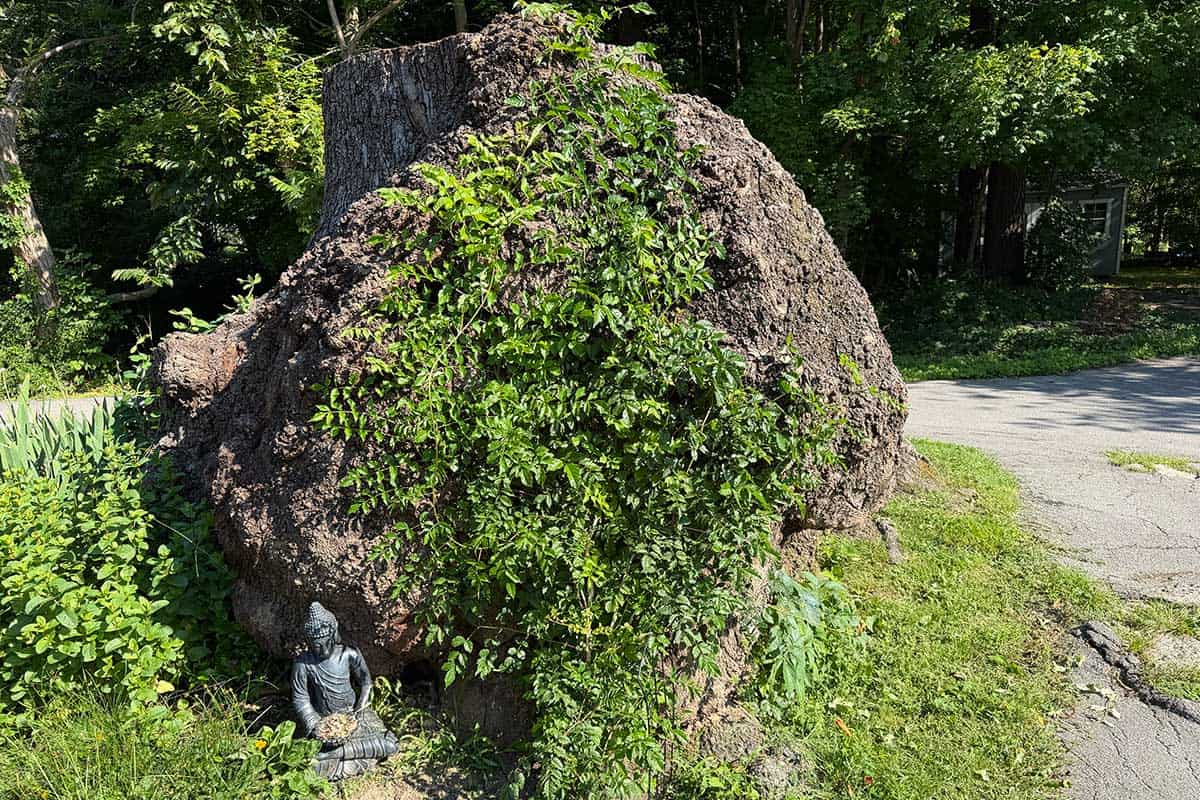
In my case, I planted trumpet creeper to cover a roughly 7-foot oak stump that could not be easily removed. I also wanted something that might eventually attract hummingbirds. So far, it has grown much faster than I expected.
Basic trumpet creeper facts
Trumpet creeper, also called trumpet vine, is a woody deciduous vine native to much of the eastern and central United States. Its scientific name is Campsis radicans.
In the wild, it often grows along woodland edges, roadsides, fence rows, and disturbed areas where it can climb over nearby supports. In home landscapes, people use it on fences, trellises, arbors, posts, and pergolas.
| Plant detail | Information |
|---|---|
| Common names | Trumpet creeper, trumpet vine, hummingbird vine |
| Scientific name | Campsis radicans |
| Plant type | Woody deciduous vine |
| Native range | Eastern and central United States |
| USDA hardiness zones | Generally zones 4-9 |
| Mature size | Often 30-40 feet or more |
| Bloom time | Summer, commonly June through August |
| Flower color | Orange, red-orange, or scarlet |
| Best sun exposure | Full sun for best flowering |
| Wildlife value | Attracts hummingbirds and some pollinators |
Trumpet creeper usually grows best in full sun. It can tolerate some shade, but shaded plants may produce fewer flowers. If blooms are your main goal, give it as much sun as possible.
Most of its active growth happens from spring through early fall. In warmer climates, the season may start earlier and last longer. In colder areas, it may take longer to wake up in spring, but established plants can still grow strongly once warm weather arrives.
Why plant a trumpet creeper?
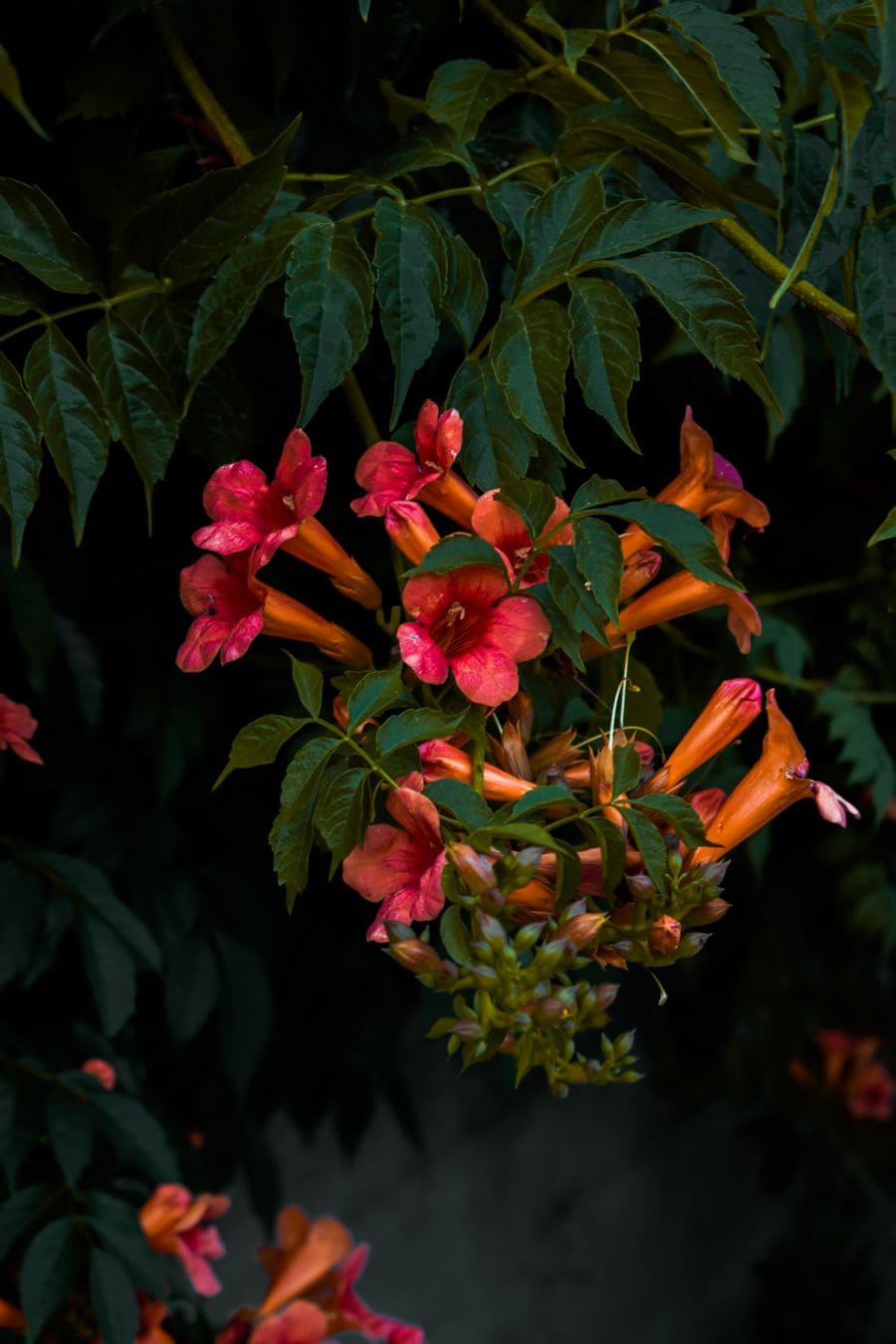
The main reason people plant trumpet creeper is for the flowers. The blooms are large, tubular, and bright enough to stand out from across the yard. They also have the right shape for hummingbirds, which is why trumpet creeper is often recommended for hummingbird gardens.
Another big reason is coverage. Trumpet creeper grows quickly and can cover things that many slower vines would take years to hide.
- Old fences
- Chain-link fencing
- Large posts
- Arbors and trellises
- Ugly corners of a yard
- Old tree trunks or natural eyesores
- Utility areas or other spots you want softened with greenery
For me, the goal was to cover a large oak stump. The beast is about 7 feet tall, probably just as thick, and not something that could be removed easily considering it is close to the house. A fast-growing vine made more sense than trying to disguise it with small plants around the base.
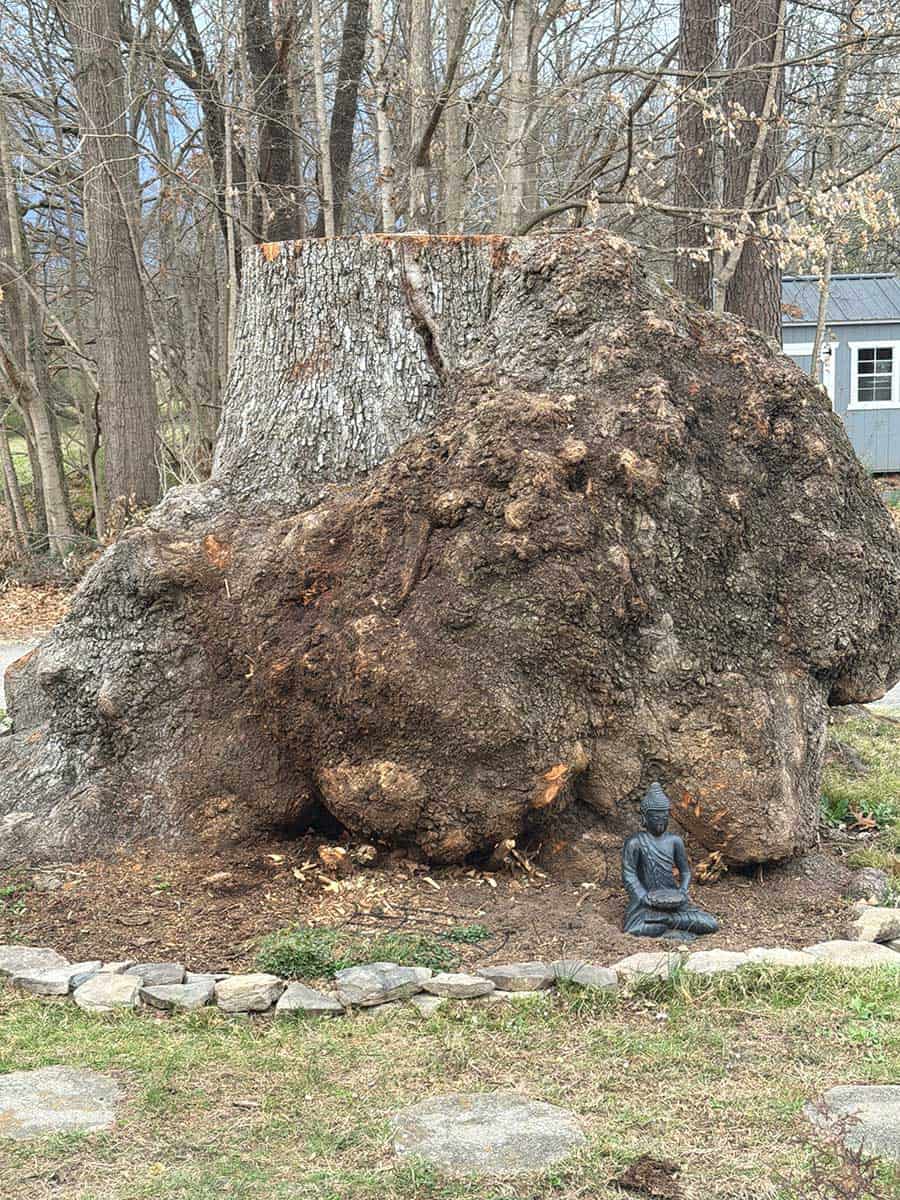
The hummingbird angle is just a bonus. If I could get the vine to cover the old eyesore and eventually produce blooms that hummingbirds would use, that would make it even better.
That is the kind of job trumpet creeper is good at. It is not just a pretty vine. It is a useful vine when you need strong growth in a specific place.
What to know before planting one
The biggest thing to know is that trumpet creeper can grow very fast. A young plant may not look like much at the nursery, but once it gets established, it can put on several feet of growth in a single season.
During warm, active growth periods in spring and summer, new shoots can grow surprisingly quickly. Growth rate depends on the age of the plant, sunlight, water, soil, and climate, but this is not a vine that usually stays small for long.
That fast growth is the whole point if you are trying to cover something. But it also means you need to think ahead.
- Give it a strong support structure.
- Do not plant it where you need a neat, tiny vine.
- Expect to prune it.
- Watch for shoots coming up where you do not want them.
- Avoid planting it too close to areas where aggressive growth would be a problem.
Trumpet creeper climbs by using aerial rootlets. These allow it to cling to rough surfaces like bark, wood, and some masonry. It can also spread from the root system by sending up suckers. That is one reason some gardeners consider it too aggressive.
Compared to many native vines, trumpet creeper is very vigorous. It is not the same as planting a slow ornamental clematis or a small annual vine. It behaves more like a serious landscape plant that wants room.
It is still a native plant with real wildlife value, but native does not automatically mean low-maintenance. Some native plants are polite. Trumpet creeper is not really one of them.
How big can trumpet creeper get?
This is probably the most important thing to understand before planting a trumpet creeper.
Most nursery plants are fairly modest. They may only be a couple feet tall, growing in a container that can easily be carried with one hand. Looking at that small plant, it can be hard to imagine what it might become.
Given enough time, a healthy trumpet creeper can reach 30 to 40 feet in length, and some specimens grow even larger. Mature vines are capable of covering entire fence lines, climbing large trees, engulfing arbors, and creating walls of foliage that can be seen from across a yard.
Unlike many annual vines that die back completely each year, trumpet creeper develops thick woody stems that become larger over time. Older plants can develop stems that are several inches thick near the base, giving them a more shrub-like or even tree-like appearance.
In other words, this is not a temporary garden plant. A trumpet creeper can become a long-term landscape feature that continues growing and expanding for decades.
What does a mature trumpet creeper look like?

A fully mature trumpet creeper often looks very different from the young plant that came home from the nursery.
Instead of a few thin vines, mature plants typically develop:
- Thick woody stems near the base
- Numerous climbing vines
- Dense foliage throughout the growing season
- Large clusters of trumpet-shaped flowers
- A substantial root system
- New shoots emerging from the base and surrounding soil
When grown on a fence, arbor, pergola, or other support, a mature trumpet creeper can easily become one of the largest and most noticeable plants in a landscape.
This is one reason it works so well for hiding eyesores. Once established, it can transform structures that would otherwise stand out into a wall of green foliage and summer flowers.
How long does it take to reach full size?
That depends on growing conditions, but trumpet creeper is often a plant that becomes more impressive with each passing year.
The first growing season is usually focused on establishment. Even though the vine may put on impressive growth, much of its energy is also going into building roots.
Years two and three are often when gardeners really start to notice the plant taking off. Growth becomes faster, coverage increases dramatically, and flowering generally improves as the plant matures.
By years four and five, many trumpet creepers begin looking like substantial landscape plants rather than recently planted vines.
Of course, the vine does not stop there. Given room to grow, trumpet creeper can continue expanding for many years. In some landscapes, the challenge eventually becomes keeping it contained rather than encouraging it to grow.
That may sound intimidating, but it is also the reason so many people plant it in the first place. Few native vines can turn a small nursery plant into a major landscape feature as quickly as trumpet creeper.
Trumpet creeper growth compared to other vines
Trumpet creeper is one of the faster native vines you can plant. It can grow more aggressively than many garden vines once established, especially in full sun with decent moisture.
It is often faster and more forceful than vines like coral honeysuckle or many clematis varieties. It can also compete with other strong growers like Virginia creeper or crossvine, depending on conditions.
It is not usually compared to something like kudzu in terms of invasiveness, but it can still surprise people who plant it without realizing how large it can get.
The best way to think about it is this: trumpet creeper is not a plant you tuck into a tiny space and forget about. It is a plant you give a job.
Cover this fence. Climb this arbor. Fill this vertical space. Attract hummingbirds here.
If you give it a real purpose and enough room, the growth is an advantage. If you plant it casually in the wrong spot, that same growth can become annoying.
Buying a trumpet creeper from a nursery
We bought ours from a local nursery for around $30. It was a medium-sized plant, probably around 1-2 years old. It was not huge, but it did have thin woody stems near the base.
At first, we were not even sure those woody stems were going to sprout much new growth. Boy were we wrong.
That is one thing I would look for again if buying another trumpet creeper. A plant with some woody growth near the base may already have a stronger root system than a tiny new cutting. It may not look impressive in a pot, but that base can matter once it gets planted.
When shopping for one, look for:
- Healthy green leaves
- No major wilting or dried-out growth
- Several stems instead of one weak stem
- Some woody growth near the base, if available
- A plant that is not badly rootbound
- No obvious pest or disease issues
You do not need the biggest plant at the nursery. A medium-sized plant can still take off quickly if it has a good root system and is planted in the right spot.
If you buy a very young plant, you may get mostly foliage the first season. That is not a bad thing. The plant may be spending its energy getting established before it starts producing a lot of flowers.
Will trumpet creeper bloom the first season?
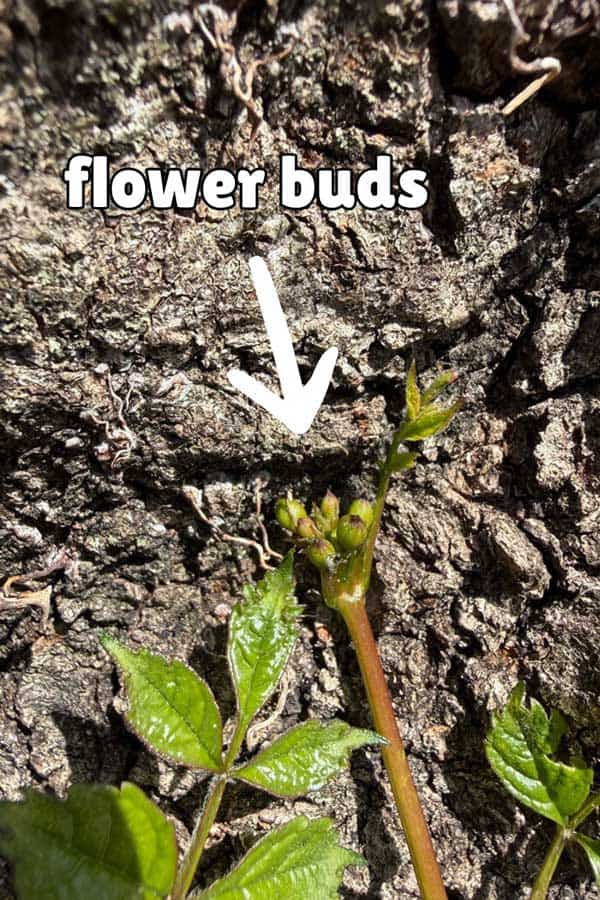
Trumpet creeper may or may not bloom the first season after planting. It depends heavily on the age of the plant and how established it already is when you buy it.
We were not expecting blooms the first season, but our plant produced a few wispy flowering stems with several dozen buds and blooms. That was a nice surprise.
Most of those blooms have since fallen to the ground, and no hummingbirds found the new plant before they dropped. That part was a little disappointing, but not surprising. It takes hummingbirds time to discover new food sources, especially if the blooms are limited and short-lived early on.
If your nursery plant already has a woody base and appears to be a year or two old, you may get some blooms the first season. If not, expect lots of green growth instead.
That green growth still matters. The vine is building size, roots, and structure. Even if the first year is mostly leaves, that can set up better flowering later.
How fast does trumpet creeper grow?
Trumpet creeper can grow several feet in a single growing season, and established plants may grow much more than that under good conditions. Mature vines can eventually reach 30-40 feet or more.
Growth is usually strongest when the plant has:
- Full sun
- Warm weather
- Enough moisture
- Room to climb
- An established root system
- A sturdy support
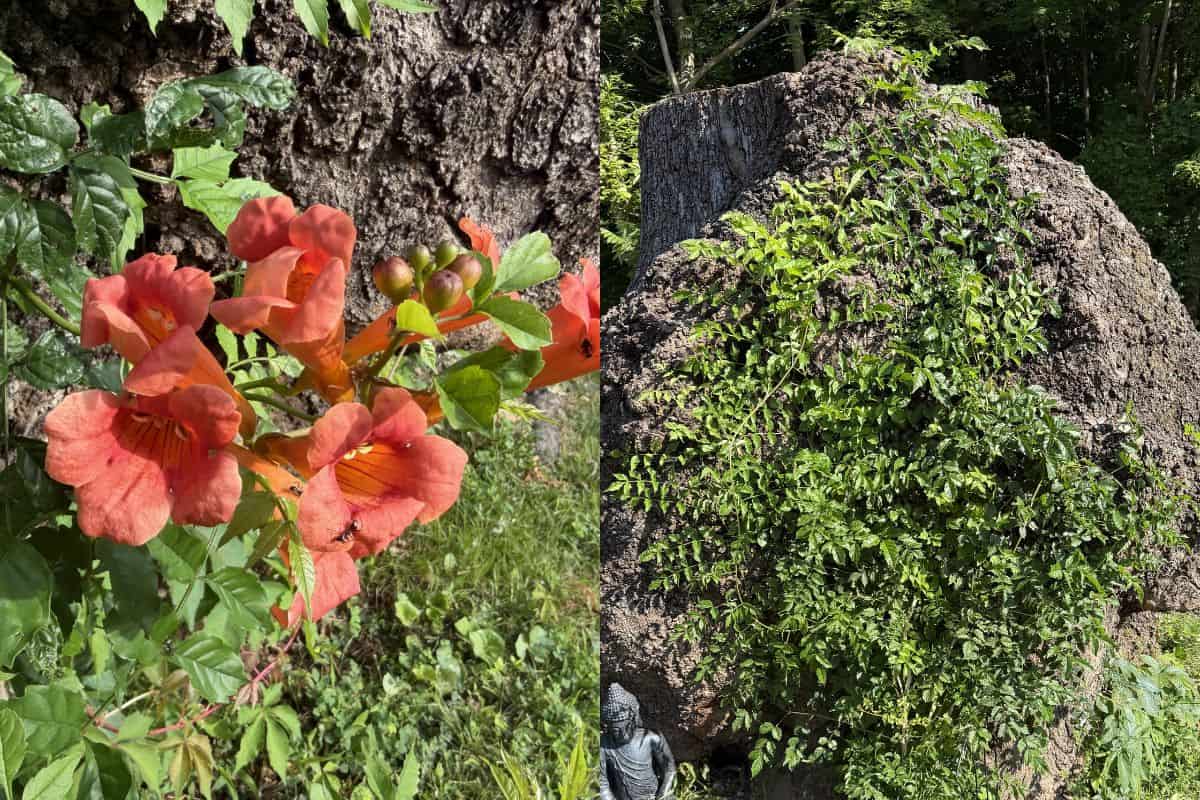
As of mid-June (see picture above), our plant has already grown faster than I expected. The season is far from over, but the growth rate has been impressive enough that I already feel good about the choice.
It has gone from a medium nursery plant with thin woody stems to a vine that is actively climbing and filling in. Based on the pictures from this post, the growth is pretty obvious.
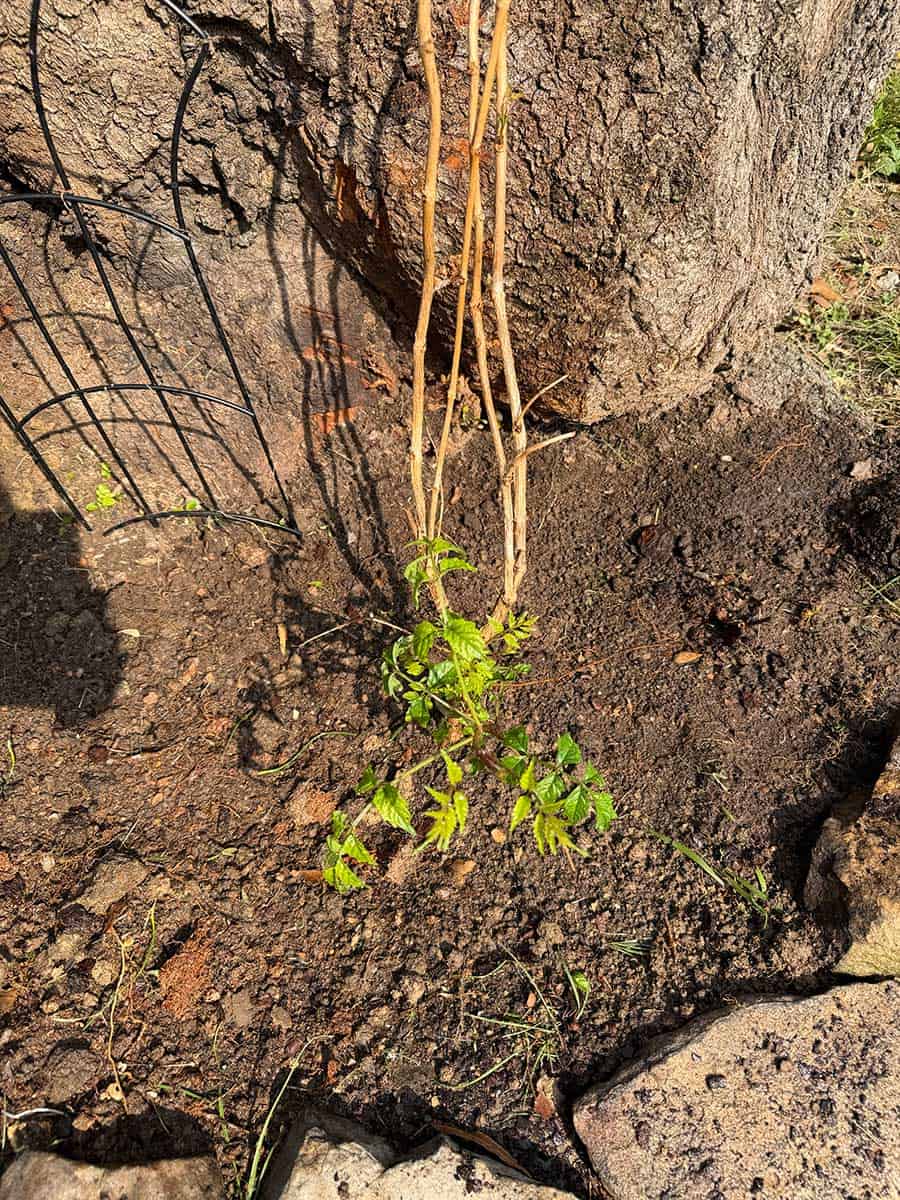
That is one of the fun parts about growing it. You do not have to wait years to feel like something is happening. In the right spot, you can see noticeable changes within weeks.
Maintenance and pruning
Trumpet creeper is not hard to grow, but it does need maintenance. The main job is pruning and keeping it where you want it.
Major pruning is usually done in late winter or early spring before new growth begins. This is when you can remove dead, tangled, or unwanted stems and shape the vine before it takes off again.
During the growing season, you may also need to trim stray vines that are heading in the wrong direction. This is especially true if it is growing near a house, fence gate, walkway, or other plants.
Maintenance tasks may include:
- Pruning back excess growth
- Removing unwanted suckers
- Guiding new shoots onto the support
- Cutting vines away from areas where they should not climb
- Cleaning up fallen blooms
- Keeping it from overwhelming nearby plants
The pruning is not complicated, but you do need to stay aware of the plant. If you ignore it for too long, it may decide where it wants to go instead of where you wanted it to go.
For a fence or strong arbor, that may not be a big problem. For a small garden bed or tight spot near the house, it could be.
Where to plant trumpet creeper
The best place to plant trumpet creeper is somewhere it has room to grow and a clear structure to climb. This is not a plant I would put in a tiny flower bed and hope for the best.
Good locations include:
- A strong fence
- A sturdy arbor
- A pergola
- A large trellis
- A dead tree trunk
- A wildlife garden with room for a large vine
Avoid planting it where the vine can easily climb onto siding, gutters, rooflines, or delicate structures. Also be careful near small shrubs or young trees that could be overwhelmed.
For our use, the tall oak stump made sense. It gave the vine something strong and vertical to climb, and it was already an area I wanted covered. I planted some native coral honeysuckle on the opposite side, I hope they will just end up growing together eventually.
That is probably the ideal way to use trumpet creeper. Give it a job where its natural growth habit is useful instead of fighting against it.
Is trumpet creeper worth planting?
Trumpet creeper is worth planting if you want a tough, fast-growing vine and you have the right place for it. It is especially useful if your goal is to cover something large or create a hummingbird-friendly feature.
The main benefits are:
- Fast growth
- Showy summer flowers
- Native range across much of the U.S.
- Good hummingbird value
- Useful for covering structures
- Tolerates heat and average soil
- Can become a dramatic landscape plant
The main drawbacks are:
- Can spread by suckers
- Needs pruning
- Can overwhelm small spaces
- May not bloom heavily right away
- Can attach strongly to rough surfaces
For me, the positives outweighed the negatives because I had a specific use for it. I wanted something vigorous. I wanted something that could climb a large stump. I wanted flowers. I wanted hummingbird potential.
In that situation, trumpet creeper made sense.
Additional trumpet creeper tips
Will trumpet creeper bloom the first year?
Sometimes. Younger plants often spend their first season focusing on roots and vegetative growth. Older nursery plants with established woody stems may produce at least a few flowers during their first season after planting.
How often does trumpet creeper need pruning?
Most homeowners will want to prune at least once per year, usually during late winter. Fast-growing plants may also need occasional trimming during the growing season to keep them where you want them.
Can trumpet creeper grow in partial shade?
Yes, but flowering is usually best in full sun. Plants grown in shade often produce plenty of foliage but fewer blooms.
How long does trumpet creeper live?
Trumpet creeper is a long-lived perennial vine. Established plants can survive for decades when growing in suitable conditions.
Will trumpet creeper attract hummingbirds?
Yes. The bright tubular flowers are one of the reasons trumpet creeper is often recommended for hummingbird gardens. Mature plants with heavy blooming displays tend to attract the most attention.
Can trumpet creeper damage structures?
Its aerial rootlets can cling tightly to certain surfaces. It’s best planted on sturdy supports and away from areas where aggressive climbing growth would be a concern.
Can trumpet creeper spread?
Yes. Established plants can produce suckers from the root system and may appear several feet from the original plant. Regular maintenance can help keep the vine contained.
Is trumpet creeper invasive?
Trumpet creeper is native to much of the eastern and central United States. While not considered invasive within its native range, it can spread aggressively and become difficult to control if planted in the wrong location.
Final thoughts
Trumpet creeper is not a plant you should buy without knowing what it can become. It may start out as a modest nursery plant, but with time it can become a large, woody vine that needs room and occasional control.
That said, the growth is exactly what makes it useful.
If you have an old stump, fence, arbor, or other structure you want covered, trumpet creeper can do the job quickly. If you want hummingbird flowers, it can help with that too. Just plant it where its size and energy are an asset rather than a problem.
As of mid-June, my trumpet creeper has already grown far faster than I expected. It even produced some first-season blooms from a medium nursery plant with thin woody stems, which was a nice surprise.
The season is not over yet, but so far it looks like the perfect vine for what I wanted it to do: cover an eyesore and eventually turn it into something much more attractive.